The second Revisiting SSI meeting was held on January 13 (for Americas, Africa, and Europe) and January 14 (for Asia). Its intended focus was on “Forming Lenses”. No working groups were definitively formed, but there were more introductions and more discussions of Self-Sovereign Identity.
Media & Slides
|
Americas/Europe/Africa:
|
Asia/Europe:
|
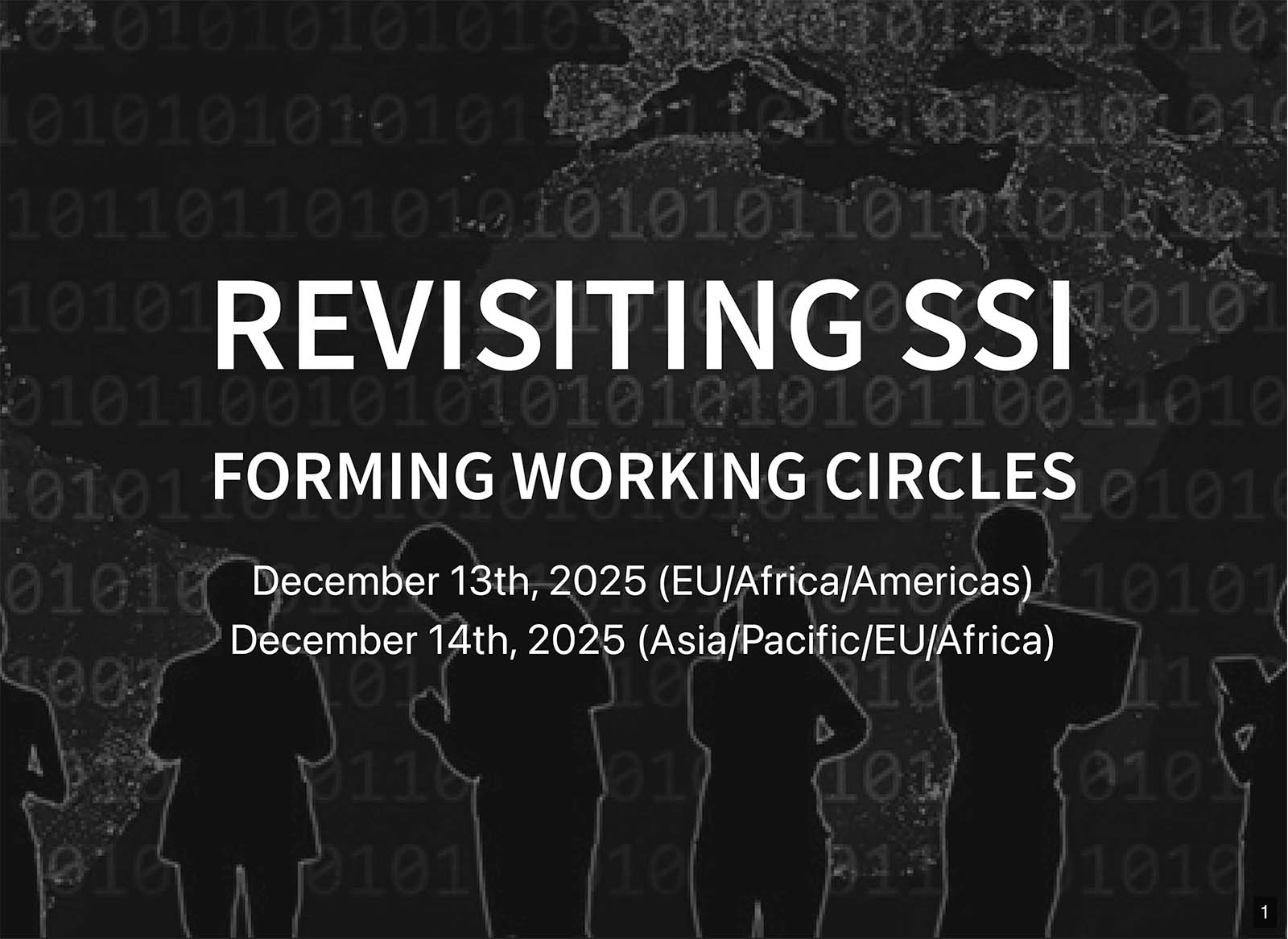
Slides:
|
Want to participate? You don’t need to have attended this meeting. Working circles are forming now and welcome new contributors. Learn how to join →
Key Points
Some of the key points from the two sessions included:
- There’s no definition of “Self-sovereign identity” (SSI). That was intentional: when Christopher wrote “The Path to Self-Sovereign Identity”, the 10 principles were intended as an alternative. That’s why revisiting and updating the principles for the 10th anniversary is so important.
- There’s a divide in talk about identity between individual (Western) and group-focused (Ubuntu) designs. One participant suggested that SSI might be more similar to the Ubuntu design.
- Anti-coercion remains an important new lens for considering SSI.
- SSI should allow for multiple contextual identities and identity experimentation, something that’s seen in large amount among younger users of the net.
- Taiwan is piloting digital wallets through MODA; details are provided in the Asia/Europe meeting.
- C2PA, which verifies media sources, is another topic of interest to SSI; details are again provided in the Asia/Europe meeting.
Didn’t attend? You can still participate
Working circles are forming now and welcome new members. Here’s how to get involved:
- Watch the videos above or skim the transcripts to understand the context.
- Browse the lens briefs and find one that resonates.
- Join the conversation on GitHub Discussions.
- Connect with a working circle via the Signal group or email list.
See How to Join for participation expectations and recommended reading.
Key Quotes
On the term self-sovereign identity:
“If it gets diluted and there’s no strong boundary to point at, that term is going to get lost and that whole movement is going to get lost.”
On C2PA:
“If everybody’s device that is able to document content… is now traceable back to the person who has that device and can’t be safely elided in some fashion to protect the sources, I think that it can lead to very authoritarian type of practices.”